Welcome to a very brief edition of Robert’s Fulbright Award Travel and Lecture Tour blog. In this segment I will introduce you briefly to the Ortobayir/Levent area of the city where I stayed at a small hotel. Hotel prices vary enormously in Istanbul. I paid the equivalent of $ 130 for four nights, including breakfast. Since very few hotels (as compared to places that advertise as “bed and breakfast” inns) provide the morning meal, this is a very good price. Unfortunately, at this price you only get instant coffee but if you like you can have standard Turkish chai (tea).
Istanbul is a famously easy city to navigate by using the metro system. The system, while not completed, is extensive and inexpensive. A single ride is 2.65 TL (Turkish Lira; Turkey is not part of the EU and therefore retains its own currency. 1 TL as of this writing is about $ .19 US) Thus, one ride costs about 51 cents. However, each time you switch lines (there are presently six lines) you must pay again. Still, I rode from my hotel to the airport for two fares – a little over $ 1 USD. The easiest way to use the metro system is with an Istanbulkart. This is an electronic payment card. Once acquired, you can easily add value to it in machines located in the stations. (Even I could do it!) The card readers work well and the system moves people through it efficiently.
The entrance to the Istanbul metro system at Bogazici University. The University is on the newest metro line, M6, which has only four stops presently, I stayed near the Levent metro strain which is the other end of the four stop M6 line, about 10 minutes actual travel time (exclusive of waiting).A painted tile wall mural on the older M2 line of the Istanbul metro system.A food and drink kiosk at a station on the M2 line of the Istanbul metro system. The stations are clean, spacious, and have working escalators as well as stairs to accommodate riders. (I emphasize “working” escalators as a comparison to many U.S. metro systems where escalators are routinely out of order for service.) Note the woman in traditional Muslim dress in the background. Modernity meets tradition in Istanbul. Near the entrance to the Levent metro station on the M6 line in Istanbul. The Levent station is surrounded by a forest of tall modern buildings and upscale shopping malls (as well as a McDonald’s, naturally).A view of part of the extended pedestrian plaza near the Levent metro station, Istanbul, showing tall modern buildings. In the foreground you can see younger Muslim women with their children, wearing head scarves, but not wearing completely traditional Muslim clothing; rather they are wearing pants and western winter coats (and one backpack).A second photo taken from the same spot but showing that there are more tall modern buildings on the other side of the principal street as well.A photo taken from just outside the Levent metro entrance showing the entrance to Kanyon, a large, upscale “indoor/outdoor” shopping mall in Istanbul.Photo taken inside the “indoor/outdoor” Kanyon Mall, Istanbul. The landscaped area is open to the sky and thus watered naturally. The stores and shops are mostly under the covered areas on either side, giving off heat in he colder seasons. The red umbrella advertises Haagen Dazs inc cream; the shop sign to the right is for Under Armor.Another photo of the “indoor/outdoor? Kanyon Mall, Istanbul. Note the high end clothing store on the second level. There are about four levels of stores in all.A toy store in the Kanyon Mall, stocked with goods from floor to ceiling. You can apparently get anything you want at Alice’s Restaurant. Street scene from area behind the Kanyon Mall on streets heading toward my small, modest hotel in a more modest neighborhood in Istanbul. In the left foreground, two women wear traditional Muslim dress but with colorful scarves. While I do not believe I have a picture to show, truly traditional Muslim dress for women is all black, including head coverings, and has only a small rectangular open panel that exposes the eyes; nothing else.Another photo of the area just behind the Kanyan Mall showing residential area of mid-size apartment buildings amidst narrow, crowded streets. Here, there are sidewalks although some streets have virtually no place to walk except next to/amongst the traffic. Narrow streets like these are the rule.Parking, Istanbul style. Squeeze car in, place it in park, leave. (Surprisingly, I am standing in a space not occupied by a car!)Taking the opportunity to “reach out” for your customers, Istanbul style.
That’s all for this session of Robert’s Fulbright Award Travel and Lecture Tour blog from Istanbul. Join me again shortly for my photographic tour of sections of the “old town” and the heart of this modern city of 15,000,000 people. (In 1950 the population was about 970,000.)
Welcome back for further Fulbright adventures in Europe. Today I write again from Nicosia, Cyprus where I have delivered two lectures at two different universities, the University of Cyprus and the University of Nicosia, in two days. My report in today’s blog, however, will provide photographs and commentary on a couple of hours spent in Bebek, a neighborhood on the Bosphorous (sometimes spelled “Bosporous”) strait in Istanbul, Turkey. Bebek, you will recall from my last blog entry, is just down the very steep hill – almost a precipice in places – from Bogazici University, where I visited for a speaking engagement at the end of last week. Here again is the last photo I showed you, a view of the Bosphorous at the bottom of the descent from Bogazici.
A view of the Asian side of Istanbul across the Bosphorous from the bottom of the winding road that leads down a very steep hill from Bogazici University on the European side.The Bosphorous strait is a historically important shipping channel that connects the eastern end of the Mediterranean via the Sea of Marmara/Aegean Sea to the Black See. Russia’s only Mediterranean ports are on the Black Sea so that the Bosphorous is a critical “warm water” link for Russia to the Atlantic Ocean and beyond. A view of several apartment buildings homes/town homes overlooking the Bosphorous in the neighborhood of European Istanbul known as Bebek. The photographer is standing on a wide seaside promenade, with two way bike trail, next to the sea wall on the channel.A photo showing a small section of the two-level promenade that runs along the sea wall on that section of the Borphorous in Bebek. There are many small, midsize, and larger pleasure crafts, ferries, and day cruise/sight seeing ships moored along the sea wall here.A modest sight seeing ship cruising the waters of the Bosphorous, Bebek, Turkey. The forested hill side is land owned by Bogazici University, originally founded as Robert College in 1863.Some of the dozens and dozens and dozens of small pleasure and deep sea fishing craft moored at the sea wall of the Bosphorous, Bebek, Turkey.Sign on one of the small pleasure craft moored in Bebek. A very high percentage of the boats moored there are for rent, confirming the time honored adage that “a boat is a hole in the water into which you throw money.” Note the proudly displayed Turkish flag.Fisherman on the sea wall, Bebek, casting.A (no doubt quite expensive) private home looking across the street and over the promenade and sea wall to the Borphorous, in Bebek, Turkey. I was told that Bebek is where the well-off choose to live in Istanbul.Private home, a shop, and minaret (for making the Muslim “call to prayer”) on the main street, Bebek, Istanbul, Turkey. (In the foreground you can see a portion of the nice bike trail as well as a bench on the promenade for enjoying the view of the Bosphorous.One of many nice buildings with apartment homes/condos overlooking the Bosphorous in Bebek, Istanbul.Another expensive private home overlooking the Bosphorous on the main street of Bebek in Istanbul.A fancy restaurant perched over the Bosphorous in Bebek.A “rear gate” to Bogazici University on the main street of Bebek. Although this is an especially nice looking post – and one with a spectacular view of the Bosphorous, which is just across the street and the promenade – it is also an example of the “little huts” that are a ubiquitous part of daily life in Istanbul. Many, many enterprises of all kinds have guards stationed at the entrances who give everyone entering the casual (or more formal) “once over” before permitting one to pass. Showing ID’s/passports often required. Behind this entry, the steep hill to the campus starts rising immediately.A photo of one of the less steep (!) segments of the uphill climb to Bogazici University from Bebek.And what tour of upscale Bebek would be complete without a visit to Granny’s Waffles? (Best Waffles in Bebek as the small red sign informs one.)
Thanks again for joining me for today’s short tour of one of the upscale neighborhoods on the European side of the Bosphorous. The next entry will take you to see some street scenes of the more modest neighborhood near Ortobayir/Levent where I stayed while in Istanbul and then walks you through “old Istanbul” and the historic center of the city. All for now.
Greetings from Nicosia, Cyprus! I’ve just arrived here from Istanbul (via Athens Airport) and – because it is raining – I am taking a moment to start my entry on my lecture date at Bogazici University and my stay in Istanbul. Tomorrow (Monday) I give a public presentation at the University of Cyprus at 5:00 p.m. Tuesday I give a public presentation at the University of Nicosia and meet with one of my colleague’s classes.
Bogazici University
My colleague and new friend, Myrto Drizou, teaches at Bogazici but only since Fall, 2018. Prior to that she taught in the United States at Valdosta State University in Georgia and the University of Illinois at Springfield. She took her Ph.D. in American literature at the University of Buffalo, picked up her first job in Springfield, moved to a tenure track position at Valdosta State – and after six years there – decided to give it up accept a position as a new starting assistant professor at Bogazici. Complicating the whole matter, her husband (an American, who she met at the University of Buffalo) left Valdosta State without a job at Bogazici and then at the last moment received a job offer – at the University of Newcastle, UK! Thus, they live a divided life right now. Myrto loves Bogazici University and her department. Bogazici has a very high reputation (some assert it is equivalent to the “Harvard University of Turkey”) and has high academic standards for admission. Also, Myrto is from the Greek island of Chios, which sits just off the coast of Turkey. Her mother, father, extended family, and many good friends still live there and she and they can travel one way or the other quite often and see each other frequently now.
Bogazici has four or five campuses in Istanbul (and one or two others elsewhere in Turkey) but the principal campuses are called the north and south campuses; they are located about ten minutes apart walking. The south campus is the “modern” campus with buildings built from the 1970’s onward. I met with one of Myrto’s classes there on Thursday morning. My lecture on Thursday afternoon was at the older, original campus, the north campus. It sits atop a high, forested cliff overlooking the Bosphorous (sometimes spelled Bosporous in English), the narrow, natural strait that separates European Istanbul from Turkish Istanbul. (The strait connects the Sea of Marmara and the Aegean Sea to the Black Sea.) Bogazici is on the European side. Originally founded by Congregational and Presbyterian ministers dedicated to education as Robert College in 1863, the institution was given to the Turkish government and now operates at Bogazici as a state institution.
The gated entrance to the north campus at Bogazici University, Istanbul. Slovenia has a penchant for placing minders/security guards in little huts but the Turks take this to the extreme. There are guard houses everywhere, for everything, with officials (mostly men) standing around to give a perfunctory look at whoever shows up to do something. Here, you must show a University ID or state your business, turn in some sort of picture ID, and get a little plastic guest pass. From the north campus gate house, one must walk five minutes along a sidewalk next to a winding road for five minutes to reach the campus buildings and quad. This is one of the views of the Bosphorous along the way.Looking down from the sidewalk on the way to Bogazici’s north campus, one sees the neighborhood on the water called Bebek (“baby” in Turkish). One of the sultans and his wife so enjoyed the coast here that they spent very little time at the inland palace to be here with their “baby.”Another view of the Bosphorous from the walk along the roadway to the center of the north campus, Bogazici University, Istanbul.One of the buildings around the quad at the north campus, Bogazici University.A view of part of the north side of the quad, north campus, Bogazici University.A view of the building that dominates the west side of the quad, Bogazici University.Another building on the north campus, Bogazici University.
The north campus is heavily forested except for the quad. It is perched on the edge of a very steep descent to the water.
A photo showing one of the “back” gates to the north campus, Bogazici University that also gives you a glimpse of the wooded nature of the hillside campus and the descent down to the Bosphorous. (And this is the “flat” part of the descent!)This is what you see when you complete your descent from one of the “back” gates at the north campus, Bogazici University. You are looking at Asian Turkey.
Thanks again for joining me on Robert’s Fulbright Award Travel and Lecture Tour blog. Next time: Bebek! And after that: old Istanbul! See you soon.
Greetings from Istanbul, Turkey! I am on the first leg of my initial Fulbright Award Travel and Lecture Tour. On February 28, 2019 I gave a public lecture at Bogazici University (the Harvard University of Turkey so I am told) and met with one of the classes taught by my friend and colleague, Professor Myrto Drizou. Here is a poster advertising my public lecture, in case you missed it earlier.
Poster advertising my public lecture at Bogazici University, Istanbul.
The lecture seemed to go well. There were 60+ people in attendance, which turned out to be “standing room only” since the room organizers only put out about 50 chairs or so. While there is more to say – and show you – about Bogazici University and Istanbul, I am going to tell you about my “working lunch” at Lake Bled, outside Ljubljana, first since I have held you in suspense on the day long enough.
Lake Bled
On February 20, 2019 I went to Lake Bled with my friend and colleague Mitja Sardoc for a “working lunch.” Mitja picked me up in his late model white Audi in front of the Slovene Parliament building at noon, which is in the “new” city center (adjacent to the “old” city center where I spend most of my time down by the river at ZRC ZASU). It took me about 30 minutes to walk there from the north campus of Ljubljana University where I live.We drove on a very new autobahn like road after we left he city for about 45 minutes to get to Lake Bled. Lake Bled is one of the most photographed sights in Slovenia. Here’s one view of what it looks like.
One view of Lake Bled. It was misty, almost foggy, part of that day so the photos are not as clear as they might otherwise be, especially at a distance and over the water.
Mitja lives in Koper, on the Slovenian Adriatic coast, with his wife and two teenage sons. His wife teaches elementary school. Mitja is fully attuned to the modern way of life. On the autobahn he helpfully explained, “Yes, Slovenia is a very small country but well-situated. Going this way, you can get to Vienna in just a few hours, and Munich, too. If you go another way, you can ski in Switzerland in a few hours if the snow is not good here, like this year.” He talks some about how Slovenia has changed from the former Yugoslavia. He was in the Yugoslavian army in 1991 when the Bosnian conflict set off. (He was briefly in both Kosovo and Bosnia but saw no real conflict although he was initially worried he would.) He recommended I go to Sarajevo (“a beautiful city”) but a destroyed city , which has only partly recovered, due to the war there.
We pulled into Bled and parked in sort of a nondescript gravel lot. We then walked toward a restaurant Mitja likes; it appeared closed so he called the owner. Later, the owner called him back and said, “We’ll be open tomorrow.” (Rule Number 1 about Slovenia: It is a small country! It is not exactly that everyone knows everyone but it is easy to know many people if one is in the professional class and travels regularly.) We started to walk around the lake but because the one restaurant was closed Mitja decided we should settle eating first (so as not to miss out, I think). It was about 1:15 p.m. or so. So we went to Mitja’s second choice for a restaurant: “This is not bad either.” Mitja talked about all the times he, his wife, and his family came to Lake Bled, which sounded often. (It is very close to Ljubljana but not so close to Koper.) He said he “owes” his older son, 19, a trip to Lake Bled which he promised him if he did well his senior year in high school. His son is at University in his first year now (not sure where in Slovenia although he no doubt told me) and studying medicine, which is an undergraduate degree here. (His younger son is 15 and a freshman in high school, which is four years like the U.S.)
Another view of Lake Bled. The church to the left is on an island that is near the center of the lake but toward one end. It is a popular place for marriages so you must book well in advance. The high precipice in the background was once used as a small fortress but then became a sort of summer palace. Today it is said to be owned by a Russina oligarch who became wealthy after the breakup of the Soviet Union, benefiting from the sale of state assets.
For lunch Mitja had the “mixed grill,” which consisted of sausages, sausages, and more sausages! (OK, and some other meat, too.) I had tuna steak – about twice the size serving you would be given in a U.S. restaurant (price: 19 euros; about $ 22 USD) with mixed grilled vegetables. (It was excellent.) We also had beef consomme (undistinguished; Mitja called it “ordinary” and he was right but as I pointed out, “I just wanted to try whatever the Slovenians were serving.”) and a fantastically large bowl of green salad, tomatoes, so forth. Then, at the end, the waiter and Mitja suggested I needed to try “Lake Bled traditional cream cake.” Need I say that this was a fantastic, gooey concoction that can best be described as a thick, deep pile of the sort of cream you would find in a Napoleon from a French patisserie topped with wafer thin layers of phyllo dough sprinkled with powdered sugar. (The sugar intake was likely so high if I had any with me I would have been tempted to eat four 500 MG tablets of metFormin right then and there.) We also had coffee. (Mitja likes macchiatos).
Lake Bled traditional cream cake (already tasted).
We then took a two hour ambling walk around the lake. The distance might have been 2 1/2 + miles or so. I took a lot of photos although there was a mist over the lake and some will have that ghost-like, mist-covered effect. We did talk about our American Dream conference project (much more on that in an upcoming edition – don’t miss it!), of course, but then we talked about other prospective academic projects for the future and just about everything. (He liked the Rolling Stones – and all rock n’ roll – when he was younger and still does. He does not follow futbol.) As dusk started to settle, Mitja said, “Shall we have a coffee?” So we had another coffee before driving back. He dropped me off on Dunajska Cesta at the bus stop across from my residence. Here are many more photos of the Lake Bled area.
A view of Lake Bled.A closer image of the former fortress/summer palace on the cliff.A closer view of the church on the island in Lake Bled.A canopy covered gondola style boat used to ferry people out to the island and church.Another view of the island church.A strange modernistic structure on the lakefront.A small conference center on Lake Bled.A traditional lake house with boathouse in the foreground. (Lake Bled)A statue at Lake Bled celebrating Slovenia’s prominence in rowing.The photo below is where the Lake Bled rowing teams’ sculls, oars, and other equipment are stored.An older rooming house at Lake Bled.My friend and colleague Dr. Mitja Sardoc at Lake Bled.Yours truly at Lake Bled.A couple of the many big hotels at one end of Lake Bled. A nice Lake House at Lake Bled.
There you have it – my day trip for a working lunch at Lake Bled. Tune in next time for highlights from Istanbul!
Later today I leave for Istanbul and then Nicosia, Cyprus. Last night, in a feverish attempt to clean out my small half-refrigerator of perishable or dated items, I prepared another two-burner gourmet meal: spaghetti! Here again is how the well-off Fulbright scholar cooks on his two burner stove top in his studio apartment, in photographic living color.
First, one must assemble the ingredients. Although I have expanded my grocery shopping forays to include both a Hofer store and a Spar store (more about these two stores later), I obtained these ingredients at the nearby Mercator grocery store on the opposite side of Dunajska Cesta about 150 meters from my residence. It is the closest grocery store but, as I have found out since, not the store with the best selection nor the best prices in every instance.
Pictured here is the first essential ingredient for last night’s epicurean feast: pasta! I chose whole grain spaghetti, the Mercator store’s house brand.While not required, I prefer spaghetti with sausage. Normally one would use Italian sausage, which I am sure is available somewhere here in Ljubljana. However, I have not seen any at the small Mercator store where I shop so I used one of many different kinds of sausage available in Slovenia: klobasa za kuhanje. (While the word “klobasa” sounds devilishly close to the Polish word “kielbasa,” which many Americans are familiar with as a very specific form of highly seasoned (often with garlic) form of sausage, klobasa is a more generic word simply for sausage. Many of the Slovenian sausages are closer to Polish than Italian style sausages but there is a side variety and range and the word “klobasa” alone tells you almost nothing.)Also optional, I add some kidney beans to my spaghetti. Here displayed is the can of “Nature’s Gold” rote (red) kidney beans. (Here the word “bohnen” is used for beans although the more common word is “fizol” in Slovenian.)
Finally, an essential ingredient for any traditional spaghetti is a red tomato based sauce. I selected a store made sauce (Yes, I could have made my own from scratch!), “paradiznikova omaka” that features principally tomato and basil (Mercator brand). The jar promises me that it is a “Slovenski izdelek” (product of Slovenia). Hence, my spaghetti is a decidedly Slovenian spaghetti with Slovenian sausage and a Slovenian style of tomato sauce among its ingredients.
By now you have probably guessed the instructions are simple. Brown and heat the sausage in a skillet in some olive oil. (In addition to browning the outside I cut the sausage into short links and slice it open, thereby browning and heating it thoroughly.) Cook the pasta til al dente or as preferred. Add the tomato sauce and some kidney beans to the sausage once browned. Meanwhile, set the table.
Table setting for one. (Includes required medications.)To accompany last night’s Slovenian style spaghetti I chose a vino rosso d’Italia by Grandi Mori , a basic (but pretty good) Italian table wine. (Like many wines here also very inexpensive: 1.99 euros for 750 ml at the Hofer store.)
Finally, you are ready to serve and eat. While many aficionados of pasta preparation would serve the pasta first with the sauce ladled on top, I have warmed the sauce with the drained pasta for another two minutes before serving. Buono appetivo!
Robert’s two burner stove Slovenian spaghetti.
There you have it! Another scintillating segment of Robert’s Fulbright Award Lecture Tour and Travel Blog, laced with more ideas for cooking on a two burner stove for your edification and delight. Don’t miss the next chapters of my blog as I will be describing my trips to Istanbul and Cyprus to give public lectures and meet with classes at three universities.
I recently wrote about some of the amenities here at my residence in Dom podiplomcev. At the time, I promised you photos of some of those amenities. Well, here they are:
The “drying area” of the Laundry Room (Pralnica). It is very popular to dry clothes this way rather than use the dryers.The washers (5) and dryers (3) in the Laundry Room at my Residence House. (One of the dryers now has a “not working” sign posted.) Use is free of charge.
There is little else to say about the Laundry Room I think.
A view of part of the Fitness Room. The security Guard who took me down to see where the room was located explained that the etymology of the Slovenian word that means “fitness” derives from a Scandinavian maritime term used to denote when a ship is well-balanced and, therefore, “shipshape” for ocean voyaging. It is in a sense, “fit” for its task. The guard didn’t recall which Scandinavian language but only that it was a “borrowed” word and not really Slovenian (but the accepted word now). Two additional views of parts of the Fitness Room at my Residence. The Fitness Room is open from 18:30 – 21:30, Mondays through Fridays and 9:00 – noon on Saturday. It is closed on Sunday. A Ph.D. student in economics, Yannis (although he might spell it Giannis) is – as he told me – “in charge.” (His English is very correct but his word choice is rather blunt.) He gets paid to workout and give advice and generally help with the equipment. He lives here in the Graduate Haus and says he has about another year to complete his degree, as he put it: “Hopefully!”One wall of the Common Room is covered with names, signatures, dates, and comments.A close up of the “Names” wall in the Common Room, Dom podiplomcev, Ljubljana.A view of part of the Common Room: sink, refrigerator, bookcase, tables.A view of the other end of the Common Room with TV, trestle table, benches. The “Names” wall is to the right in this photo.
There is my quick photo update of the amenities here at the Graduate Haus. I used the Fitness Room for the first time earlier this evening for about 30 minutes. The only exercise I have received since January 14 is walking (and running for trains, buses, or airplanes). I must admit that the exercise felt good. I plan to use the room more often.
But first I must remind you that starting tomorrow, February 27, 2019 I will really embark on the Lecture Tour part of my Fulbright experience by flying to Istanbul, where I will speak at Bogazici University. Then, on Sunday, March 3, 2019 I will fly from Istanbul to Nicosia, Cyprus to speak at both the University of Nicosia, a private university, and the state supported University of Cyprus. Here is the poster my friend and colleague, Myrto Drizou, put together for my talk at Bogacizi University (where I will also meet with classes):
Poster for my upcoming February 28, 2019 public lecture at Bogazici University, Istanbul.
Thanks to those of you following my exploits. I hope to be able to keep up with regular postings over the next ten days but I will be traveling – and gathering new experiences and new photos for my blog even if I am somewhat delinquent in posting as often as I would like. Best to everyone.
Welcome back to another edition of Robert’s Fulbright Award Travel and Lecture Tour blog. I have recently been wandering the city streets again and therefore I have many more photos of the city of Ljubljana. One of the things that has become increasingly evident as I familiarize myself with the city is the number and scale of many examples of wall graffiti that can be seen here. In some sectors of the city it seems that there is not a wall or space in sight – including doors and windows and everything else you can imagine – that is not covered with graffiti. I haven’t been able to confer with my Slovenian informants yet (because it is the weekend) but hopefully I will gather more information from them as to their perspective on the issue. Here, now, however is a gallery of photographs of Ljubljana graffiti.
Graffiti
One small section of a block long fence covered with graffiti.Graffiti on a brick building, Ljubljana, Slovenia.Graffiti on a building near the downtown area, including anti-Semitic graffiti (“Jewman”), Ljubljana, Slovenia. More graffiti, Ljubljana, Slovenia.More graffiti.Still more graffiti.Still more graffiti.Even more graffiti.A side of a building with graffiti, some of it ten feet high.A door thoroughly covered with graffiti, Ljubljana, Slovenia.
Well, there you have it, folks. A quick and dirty look at some of Ljubljana’s graffiti, which is widespread. I will investigate this matter further and try to discern the perspective of some of the locals on the phenomena. In the meantime, ciao!
Welcome back, kids. Sorry for the brief hiatus but I was called to attend to some of my official responsibilities here. On Wednesday, February 20, I was taken on an outing to Lake Bled, about 45 minutes from Ljubljana, for a “working lunch.” The trip will be the subject of a blog entry shortly (as soon as I download the photos). On Thursday, I went to the Research Centre to work in my “borrowed” office for the first time. That, too, will be the subject of a blog entry at some point. Today, however, I will expand the limited discussion to date of the additional amenities associated with my luxurious accommodations here at Dom pediplomcev (Haus for Graduate Students) and provide more context for its location at the north campus of the University of Ljubljana.
Amenities
In addition to the free housing here I also receive free internet (WiFi). This, of course, permits me to stay in touch with all of the American celebrity news I would otherwise be missing. (Flash: Jennifer still wants to have Brad’s baby!) If a resident does not have a laptop or other means to reach the internet, there is a computer room on the 2nd floor. Access and use is free; printing can be completed and picked up near the Reception Desk at the entry foyer on the ground floor.
The Reception Desk is staffed 24/7/365. So far, there are two “regular” security guards who appear to work 40 hour shifts each and two additional guards who either work part-time, weekends and/or, perhaps, work the midnight shift when I do not see them. (The partying I do here is so frequent and protracted that I can’t be counted on to show up back at the Residence until midway through the day shift. Even then I am likely so bleary I probably don’t even recognize which guard is on duty.) All the guards are male.
The two regular guards speak English quite passably. (The two other guards have yet to acknowledge I exist. Of course, since I don’t speak Slovenian there is a sense in which I don’t exist here or, perhaps one could say I only exist.) The one (afternoon/evening) guard has told me he has a master’s degree in Public Policy. He’s interested in criminal justice and checked me out on the internet so he wanted to talk to me about “concealed carry” and other gun laws in the U.S. He, in turn, told me about the requirements here. (Generally, you must register all firearms and be approved to possess them. He characterized the background checks as thorough and said you must wait “about a month” to get approved.) He owns seven firearms and says that he likes to do target shooting, not hunting. He was in the Army (not clear on whether the Slovenian Army or the former Yugoslavian Army).
Laundry, Common Room, and Fitness Room
I mentioned earlier that there is a laundry room in the basement, Level -1. (The basement has three levels: -1, -2, and – 3. There are some living accommodations on Level -1 along with the three public use rooms; I have not been to Levels -2 or -3, nor have I inquired about them. I think it is unlikely that they are used for meetings of the witches’ covens one hears about occasionally.) There are five washers, three dryers, and a number of drying “trees” one can use in the laundry room. The drying trees are rather popular. I was given a brief tutorial on the washers when I first used one by a male resident who knew I was not native and new. I’ve followed his technique successfully since. And although I received a quick primer on a dryer the same day, I have yet been unable to reproduce the flow of warm or hot air; I seem to keep finding settings that only blow cool air. It is a learning experience as they say. (All the markings and guides on both washers and dryers are solely in Slovenian. If it comes down to it, I may need to sue the Slovenian government for discrimination against foreign English speakers.)
Normally I would have one or more photos of the laundry room (pralnica, by the way) to show you but my support team only took the photos earlier today. When they are downloaded and the battery re-charged they will become a part of another blog entry. I really do not think waiting will hurt you.
I went to see the “common room” (sometimes called the “club room” – “klubsk” is the word in Slovenian) today for the first time. It was empty this afternoon. Like the laundry room you must fill out a log and obtain a key to use either of these. The common room was a pretty unappetizing place but, of course, a dozen people eating pizza and drinking beer would no doubt liven it up. It has a mid-size refrigerator and another two burner cook top set-up plus sink. There is a modest flat screen TV (about 24″) high up in one corner of the room near the ceiling. There is a picnic style table, a number of benches, another table or two, a bookcase with 15-20 paperback books on it, and a few chairs. One wall is completely covered with signatures, dates, and comments, most probably along the lines of “so and so was here, 2005.” Photos to follow.
This evening I also went to see the fitness room for the first time. The fitness room, unlike the other two public use rooms, does not require a key. Rather, it is open on a schedule, largely in the evenings. The room is about 24 feet square. It has three step machines of various types/vintage, an exer-cycle, rows of dumbbells on a holding rack, hundreds and hundreds of pounds of free weights as well as the racks and benches to use them (but only a handful due to the room size), and probably many another small thing I overlooked in my brief visit there. Photos forthcoming.
Daily Room Service
One of the first things that happened on my first morning here was a ring on a doorbell (I didn’t even know I had a doorbell!) and some sharp, indecipherable words (partly because they were in Slovenian). About the time I realized the call out was for me, two youngish, but looming toward middle-aged, women came bustling in saying “Dobler dan!” and proceeded to empty trash, mop the bathroom, clean the shower and toilet, empty the recycling containers, and hustle back out. Elapsed time: maybe, at most, ten minutes. This, it turns out, was the “daily” room service/cleaning.
There are several things to note about this service. First, it has never turned out to be “daily” even though that is the way it is described in various welcome materials provided in the desk drawer here in the studio. (Among other documents there you can find the “rules and regulations” for studenski dormitories, all 61 provisions, about 30-35 pages!) My apartment has not been cleaned on any Saturday or Sunday even though that is not what is written in the materials; no exclusion is mentioned. Indeed, I haven’t really been able to identify a definite pattern yet to the cleaning. For example, there always seems to be one day each week when the cleaning just does not occur. Also, the materials said somewhere that there would be bed linens and towels exchanged by the cleaning staff every Wednesday. Then, about a week after I was here I read a notice in the elevator that apologized, saying the exchange would happen on Thursday that week. However, I was reading this on Tuesday and my bed linens had just been changed that morning. In fact, if there is a pattern, Tuesday seems to be a more common day (but not always) for my linens and towels to be changed. You should not receive the impression that I am complaining about the service! Rather, like everything else here – which is often a mystery – I am simply trying to make sense of it.
For those of you fretting over inequality, gendered occupational roles, and similar concerns, let me say right up front that I am on it. Having not even been here three weeks yet, I sat both of my cleaning women down and explained to them Marx’s theory of class struggle and alienated labor. I made it clear that the bourgeoisie were oppressors because of their class location and that they only had to organize with their peers, the male security guards, and rise up collectively to throw off their yoke. (I tried to remember the exact words Brian Barnes used at Saint Martin’s but perhaps failed to manage it effectively.) Of course, one of the cleaners speaks no English whatsoever. The second, when I pointed to the three small recycling containers labelled in Slovenian, pointed at them herself and offered up, “Paper! Plastic! Food!” Thus, after just a few minutes of my peroration on capitalism and class struggle, the first cleaner excused herself to go out on the balcony and smoke while the second cleaner’s eyes glazed over, her head tilted forward, and her chin fell on her chest. (For the one cleaner, smoking breaks appear to be one of the integral job benefits of her cleaning position; I frequently see her smoking out on the balcony by the elevator. Smoking in general, by the way, is much more common than in the United States. More on that later when I discuss: Slovenian Youth.)
Returning briefly to the recycling bins, it is all much more complicated than my cleaner explained. First, the bin with the word “odpadki” on it she identified as for paper. However, the “food” bin she pointed to is labeled “bioloski odpadki” and below that says, “Bio-Waste.” Moreover, I have also seen other large dumpsters on the street labeled “Odpadki” and then beneath that word, “Waste.” (The so-called “plastic” bin in my apartment is labeled “embalaza.”) So I ask you: where does cellophane go? How about tin cans? Glass bottles? I have no answers. As a practical matter, however, I put things I don’t know what to do with (cellophane) in the trash can beneath my desk with kleenex and sticky notes; I put glass bottles, wax cartons, and tin cans on top of two of the labeled recycling containers. No complaints from my cleaners; they seem to think this system works fine.
Location
Finally today I will try and expand your understanding of the location of my residence in Dom podiplomcev. The Residence Hall is about 50 -75 m off Dunajska Cesta, a major roadway, at Gasarjeva 9. The first morning I went out my balcony door and took the following photos, scanning right to left, and walking as far around my corner balcony as I could.
The view, on a foggy morning, just outside my balcony door, looking north. Successive photos taken from my balcony scanning north-west-south.Continuing to scan west and then in successive photos to the south.A very poor photo. At least I can attribute some of its failure to the foggy day.A very light snowfall on the night I arrived left a thin cover the following morning. This photo is directly south from my balcony and shows part of the University north campus.A somewhat better photo directly to the southwest (showing University of Ljubljana buildings).A photo from my balcony to the southeast showing the University of Ljubljana north campus.
Later, I began to explore the north campus area on foot.
Earlier I showed you a photo of the Faculty of Social Sciences Building at the University of Ljubljana’s north campus; here it is again.
The Social Sciences building is directly behind my residence with a connecting exterior walkway from the rear door of my building to the rear door of this building, a distance of about 100 feet. The building has a small coffee bar, bookstore, classrooms, a stadium seating auditorium, another event space, a social sciences library on the 2nd floor, and faculty offices (including the faculty office of Dr. Breda Luthar, a sociologist and wife of the director of the Research Centre, which is my official home).
Just beyond the Social Sciences building is the Faculty of Economics building. It is much larger and more grand. Here are several photos.
Well, you get the idea.One view of the Economics Building, University of Ljubljana.A different side of the Economics Building.A third photo of the Economics Building.
Here are a series of photos of walkways and dormitories at the campus, all located within a few hundred meters of my Residence Hall.
One of the main walkways at the north campus, University of Ljubljana. (Classes were not in session. In fact, they will start on Monday, February 25, 2019. Students have been on campus milling around for about a week now.)Dormitory Buildings, University of Ljubljana north campus.Dormitory Buildings, University of Ljubljana.A sign announcing, as you can read, a “Residence Hall of Secondary Students.” This is on the University campus. My informant was not familiar with this program but suspected it was for high school students from the hinterlands who wished to attend a better high school here in the city with such things equivalent to advanced placement classes.
The living quarters for the secondary students on the University campus.
Well, I’m afraid that’s all we have time for today. I hope you are enjoying Robert’s Fulbright Award Lecture Tour and Travel blog. Thank you for the many cards and letters I have been receiving. I appreciate the compliments on the high quality graphics. With regard to those of you who have requested a fast-paced video, action packed thriller episode, let me assure you that is coming shortly! Until then, hasta luego.
Welcome back to the exciting story of my Fulbright experience in Slovenia from February 1 through May 31, 2019. It is good to see you again (even though, of course, I can’t see you; and you can’t see me; but nevermind!)
Today I will take you back to one of the very first “nice” days since I arrived. After a meeting with my colleagues Dr. Oto Luthar and Dr. Mitja Sardoc, I took the opportunity presented by non-rainy, moderately good weather to visit Ljubljana Castle. You may recall that Ljubljana Castle sits high atop Castle Hill overlooking the Ljubljanica River and the “old” center of Ljubljana. You can look at a Google map to show you the Castle’s location in Ljubljana. (Look for Ljubljana grad; grad is the word for “castle” next to a green blotch, which is the forested hill and grounds.) Here is an earlier photo I showed you:
Ljubljana Castle looming over the Ljubljanica River area of the city.
Since my meeting with Oto and Mitja was at Novi trg, I wandered south along the river taking a few photos. I crossed a bridge to get a better look at a large church and took a few photos. I realized at that point that the streets to my left were starting to rise on an incline. The grade quickly became steep and I further realized that I must be climbing the back of Castle Hill. Sure enough, I soon saw a small sign pointing me uphill toward Ljubljana grad. Here are photos of the two churches I walked across the river to take a look at that day.
One of many beautiful stone churches in Ljubljana. Once again, the church was not open so I could not go inside.A detail shot showing ornate statuary around the door of the church pictured above.A second beautiful church in Ljubljana, almost directly behind the church just pictured.
Statue inset into the wall of the second church pictured directly above.
As I saw, and then photographed, the first of these two churches I also saw beyond it an arch over a primary roadway. While clearly of modern construction, it is built where the city wall would have once stood and a gateway into the city would have served much the same purpose.
Arch over major road in Ljubljana along where an ancient city wall would have stood.
Since the path up Castle Hill to Ljublana Castle presented itself, and the day was pleasant, I began to climb. Here’s a photo that gives you a sense of the steep incline:
The path up the back of Castle Hill, Ljubljana, Slovenia.
The steep incline of the hill naturally presented some dilemmas for those constructing dwellings there. Here is one interesting solution to that problem – a house built to the shape of the hill with a foreshortened front door. (Watch your head!)
A hillside dwelling on the way up the back of Castle Hill, Ljubljana, Slovenia. The door you see pictured is about 5 feet high.
Finally, after more of the very steep (but not exceedingly long) climb, I crested the back side of Castle Hill and spied the exterior of Ljubljana Castle from nearby.
The “back” of Ljubljana Castle as one crests Castle Hill from the back side. Note the garage entryway. The Castle was left neglected for many years but has in recent decades undergone extensive renovation that involves, in many places, re-building. While many parts of the Castle are original to the 17th, and perhaps earlier centuries, some sections of the Castle now “sit” on modern concrete foundations, as you can see here.
The Castle is now a gentrified tourist attraction. Admission costs 7.50 euros for an adult. However, most people do not walk up the hill as I did. On the front side a funicular (sometimes called a funicular railway) hoists you up and lowers you down – for a fee of 4.50 euros when the tickets are purchased with an entry fee (12 euros total, in other words). (A funicular operates by cables pulling the cars up, or lowering them down, a railroad like track; part of the mechanical design is premised on counter-balancing the car going up with a corresponding car going down.) Of course, you can also purchase an audio guide to the Castle, a family package plan, etc., etc., etc. I just paid the 7.50 euro entry fee.
A view of Ljubljana Castle from outside the Ticket Kiosk. The entry ramp to the Castle is to the right. Another photo of a different part of the Ljubljana Castle exterior from the same location.One view of the interior of the Castle grounds taken after you enter through an arched walk.A very restored (i.e., completely re-built) part of the Castle that permits you to climb a circular metal set of stairs so you can access the Castle catwalk (look to the upper right). View of the interior layout of the Castle from the wall catwalk.One view of the city of Ljubljana from Ljubljana Castle with snow-covered mountains in the background.
The history of the castle is too long for me to recount here. There have been Roman coins found there as well as leaden coins from 1169 A.D. In 1335, the Duchy of Carniola (a region of Slovenia that includes Ljubljana) came under the control of the Hapsburgs. Duke Frederick III assumed royal authority for the newly anointed duchy. Over the centuries the Hapsburgs showed little interest in Slovenia. Frederick made some changes and improvements to the Castle but then left Carniola largely on its own. In 1515 there was a peasant revolt and the Castle was attacked but the Hapsburgs were able to repulse the attack. While the Castle apparently served as both a residence and a fortress up into the 17th century, there is little detailed record of the use the Hapsburgs made of their royal treasure. (They were seemingly too immersed in empire building elsewhere to take much time or invest much energy in Slovenia.)
Beginning in the mid-17th century, the Castle was put to other uses. Initially, its suitability as a fortress led successive regimes to house military battalions there but was finally reduced to simply being a military warehouse. This ultimately proved to be a problem as storing large quantities of black powder created a dangerous situation.Reportedly, blasts were set off due to lightning or other accidental means in 1630, 1686, and 1737, with a devastating fire in 1774 that induced the Hapsburgs to consider tearing the Castle down. These plans were thwarted when the French occupied Ljubljana in 1797 during the French Revolutionary Wars (1792-1802) for the first time. A re-occupation by the French in 1809 during the early Napoleonic Wars continued to mire the future of the Castle in an indeterminate limbo. Although the Austro-Hungarian Hapsburg empire reigned over this part of Slovenia in principle until 1918, much of the last one hundred years of its control was characterized by neglect. The Castle was one recipient of this neglect.
After 1815 when the Hapsburgs regained control of the Castle it was converted to use as a prison for felons serving 10 or more years from the regions of Carniola and Carinthia. Although the Castle fell into complete dis-use from 1848 – 68, it served again as a prison until 1895 when it again fell into dis-use. During this period, the mayor of Ljubljana, Ivan Hribar, bought the Castle, which later became an important development. With the start of the First World War, the Hapsburgs again found use for the Castle and requisitioned it – this time as a redoubt for political prisoners. Ivan Cankar, one of Slovenia’s most honored writers, was a prisoner there beginning in 1914 because of his views regarding the war. As the war progressed, the nature of those imprisoned there changed. From 1915-18 the Castle primarily held Italian prisoners of war in quarantine before they were shipped off to other encampments, although many spent as long as a year or two in the Castle. During World War II the Castle was again used as a prison but this time as a prison operated by the Italian Fascist regime of Benito Mussolini. After Italy’s surrender the prison was briefly operated by the Germans prior to their eventual defeat. Before, in between, and after the two world wars up until 1964, the Castle was used to house poor people who had nowhere else to live in the Slovenian capital. Thus, the 150 years from 1815 onward was a period of long, slow decline for the Castle. Serious renovation began in 1964.
A (restored) mammoth underground gallery in Ljubljana Castle that likely would have been used to store munitions and/or quarantined prisoners in different eras. Its current use: for an art installation.A very poor photo of the chapel, which dates from 1747, at Ljubljana Castle.A much better photo of the frescoes on the ceiling of the chapel, Ljubljana Castle, from 1747.Sturdy, barricaded door to one cell area from the days of the Castle’s use as a penitentiary.A cell – about 6′ x 8′ – in Ljubljana Castle from the period in which it was used as a penitentiary. This cell has been retrofitted as a display room with lighted floor (not present when Ivan Cankar was imprisoned here) and interactive display panels on the walls. Here you could view hundreds of photos from different periods of the 19th and 20th centuries. There were photos of soldiers in formation in their uniforms who were stationed at the Castle when it was used as an army barracks. There were hundreds of photos of Italian soldiers quarantined in the Castle during WWI. (One of the guards bought a camera and became an unofficial photographic historian of Castle life during this period. There were photos of workshops, gardens, the commandant’s family (who lived in the Castle), the guards and their wives – wonderful photos.)
This part of the Castle was in some ways the most interesting. While discussed as cell housing for prisoners, you can well imagine that soldiers where bivouacked temporarily in these same cells when regiments were stationed here and space was short. There was little discussion, for example, of architectural or construction changes that needed to be made when the Castle went from a penitentiary for felons, to military housing, to a detention camp for political prisoners and then, later, for prisoners of war. Ergo, effectively the one and same facility will do just fine for each group!
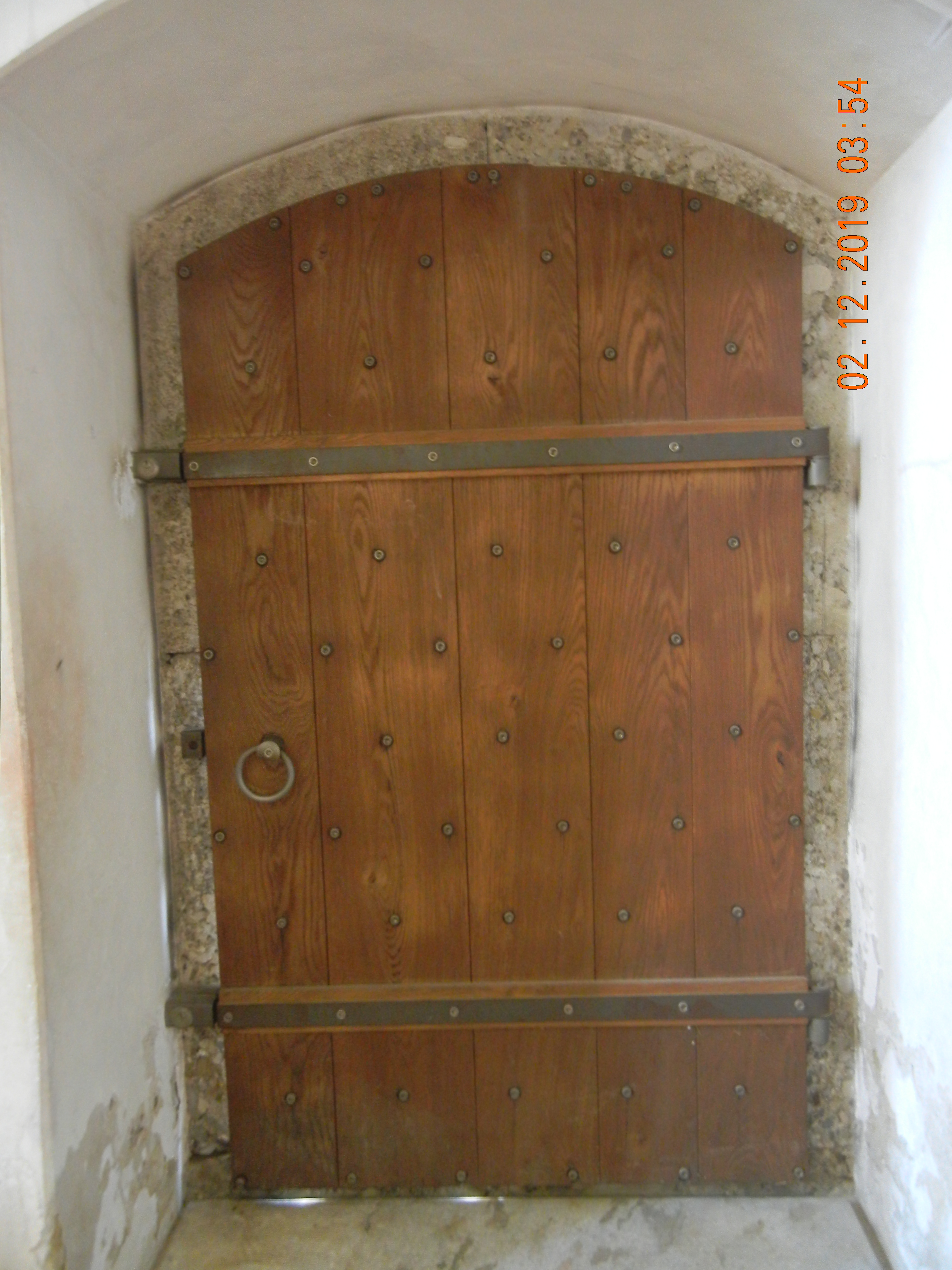
Looking down a corridor of cells in Ljubljana Castle.. In addition to the formidable cell doors I am standing in front of another very sturdy door that would be barred.A plaque in the cell area of Ljubljana Castle commemorating one of the honored commandants who ran the penitentiary for several decades.A view of one of the cells through the cell door, Ljubljana Castle. This cell had a window and an open style cell door; most cells in the Castle had neither. Rather, the. sturdy cell doors were either all word or only with a small aperture (with a cover) at face height and no window.A more representative cell door at Ljubljana Castle.
The final set of photos I will offer you will show the extent of the restoration that the Castle has undergone in recent decades.
The underground “theater” beneath one portion of Ljubljana Castle. Plays and other events are produced here. Stacks of folding chairs are set off to the side; there are modern men’s and women’s restrooms off to the right; as well as a coat check room. Construction of the theater was pursued, in part, apparently to shore up segments of the Castle wall with a new foundation.A building in the Ljubljana Castle complex that houses (behind the first floor arched windows you see) a gourmet restaurant described often as one of the best (and most expensive) in Ljubljana. A fancy reconstructed wall of a building at Ljubljana Castle. Most of this building is dedicated to a very large souvenir shop that is filled with very expensive toys and other such paraphernalia. The Castle apparently has a cartoon character mascot whose visage is imprinted on everything from coffee cups to tote bags to kids’ backpacks to, well, you name it. A pure overdose of bourgeois materialism.
And last (I was only fooling when I said the gentrified areas of the Castle would be the final photos), photos of two emblematic structures from the fortress’s days of defending the city and empire.
An aperture in the Castle’s fortifications that would permit a soldier using a musket or rifle to shot those attacking from below from safely behind an 18 inch think stone wall.
A reconstructed well near the new “theater” – so hidden underneath the Castle – that led to a means of escape to the outside. Thus, one could be lowered 40-50 feet down into the well whereupon a break in the well wall wold permit one to exit the well chamber and eventually the Castle.
There you have it, boys and girls, another installment to Robert’s extraordinary Fulbright Award Travel and Lecture Tour blog. Do not miss another exciting episode as we return to a discussion of the amenities that accompany my opulent studio apartment as well as more photos of its location on beautiful Dunajska Cesta and the north campus of the University of Ljubljana. Until next time!
Today I will fill you in regarding my original Fulbright assignment and my relations with the Research Centre for the Slovenian Academy of Sciences and Arts, my host institution, here in Ljubljana. My esteemed colleague, Victor Kogan, asked for an update along these lines in an email just yesterday so I will dedicate today’s discussion to Victor.
The Fulbright application process requires applicants to submit a five page, single spaced proposal. Generally, The IIE/Fulbright folks want the proposal to fall into one of three categories: teaching, research, or teaching and research. Following that general model, I prepared two earlier proposals for a very established – and probably very competitive – program slot in Norway for 2016-17 and 2017-18. I followed the examples the Fulbright folks provide for applicants and reviewed Jeff Birkenstein’s application to Russia a few years back. I was named an “alternate” for the grant award two years in a row for Norway. Having learned that the key to a successful application is a letter of invitation from a host institution – and, even more to the point – a highly individualized, strong letter of invitation, I made a point to secure a very strong one for my application to Slovenia.
The Letter of Invitation
The story of how my application to Slovenia came about is a good one. A handful of you have heard it already but to most it will be new. Briefly, in June, 2017 I was idling away my time in Maine when I received an email from my now esteemed colleague Dr. Mitja Sardoc of the Educational Research Institute here in Ljubljana. You read about him briefly in one of my very first blog posts. (If you have not read the links, just scroll down until you find them; they are still there; that is the beauty of this format.) Mitja asked me to write a paper for a special issue of an academic journal (Solsko Polje) he was preparing on the American Dream. Mitja related that he had read my book, Seeking the American Dram: A Sociological Inquiry (Palgrave Macmillan 2016) and a paper I published in the American Sociologist on the topic. In the course of discussing the paper he sought I inquired whether he was familiar with the U.S. Fulbright program. I explained that perhaps he could recommend a University that might have an interest in hosting an American scholar of U.S. society. Mitja said, “Yes, of course. Give me a week.” When Mitja got back to me he said, “Dr. Oto Luthar, director of the Postgraduate School of the Research Centre of the Slovenian Academy of Sciences and Arts would be happy to host you. What does he need to do?.” Rather stunned, I wrote back, “He needs to write me a letter inviting me.” Mitja replied, “Well, can you write it?” I said “no” to that offer but did send some guidance on what the Fulbright people were looking for generally.
The Fulbright Application Process
This background is important because I knew very little about the Research Centre and its postgraduate school when I received the letter of invitation from Dr. Luthar (which I was welcomed to revise as I saw fit!) and when I submitted my application to the Fulbright program. What I did, rather, is that after I received the letter of invitation I sent to Dr. Luthar a draft of my Fulbright proposal. Characteristically, as I now have found out, Dr. Luthar simply said, “That will be fine,” when I asked for his comments. What I had proposed was teaching for “60%” of my academic time (which I assumed might be two courses, or even only one) and then “40%” research (and outlined an interview study – an extension of a study I have had Saint Martin’s student’s conducting – which I would carry out). Since the Fulbright folks require applicants to submit two course syllabi (one undergraduate course and one graduate level course) for any teaching award, I naturally did so and sent those to Dr. Luthar as well. I never heard another word about those.
Selection for an Award
Fulbright applications are due at the beginning of August each year and I submitted mine on time in August, 2017 for an award for 2018-19. I received notification in March or April, 2018 that I had been selected to receive an award and notified Dr. Luthar immediately. In July, 2018 I went to a “pre-departure orientation” for Fulbright grantees in Washington, D.C. There I was told by two Fulbright grantees from the prior year that it was necessary to gently “prod” or “remind” people in Slovenia sometimes regarding things that needed to happen. I was told, “If you ask 3 or 4 times for something to happen, the Slovenians will eventually say, “Why, of course,” and you will get whatever you have asked for.” Following this advice, I started inquiring about what classes I would teach in Spring, 2019 in a series of emails during Fall, 2018. At first I received no reply, whatsoever. Then I received a cryptic email from Dr. Luthar suggesting I make up “two lectures.” I parsed this as “two series of lectures” (i.e., a course outline of lectures for two different courses). I sent this along and heard nothing. When I inquired I was told what I had sent was “fine” and could I now just select two of the topics and draft two lectures?
The Short Series of Lectures
So I started doing so, but the first lecture turned out to be far too long and I split it in two, leaving me with three lectures, not two. I sent the three along to Dr. Luthar and explained that I thought I should perhaps do four lectures, as it was sort of becoming apparent that I might not teach very much. Indeed, even though I raised it a number of times – including twice in my first ten days here in early February – I’ve never received any acknowledgement of the issue except for oblique references to the “importance of the lectures you will be making; I will insure our students attend.” After my proposal of four lectures in the Fall, I prepared the fourth lecture. Since I had just finished writing a book [The Lonely Quest: Constructing the Self in the Twenty-First Century United States (Routledge 2018)] I drafted the fourth lecture based on my new book.
In mid-November, 2018 I sent along this fourth lecture to Dr. Luthar. A few weeks later he wrote that he had looked at the Spring events schedule and thought there would only be time for three lectures. We agreed on Mach 13; April 3; and April 24.
In sum, it started to become apparent that Dr. Luthar was happy to invite me to his institution, but there was apparently no serious intention paid to the content of my teaching proposal to the Fulbright people (if Dr. Luthar even read it!) As things have turned out we are still looking toward just three lecture with the addition of one more event: a small, regional conference on the American Dream in mid-May. In the little I have learned since I have arrived here, one factor related to my teaching/not teaching is no doubt the small size of the postgraduate school at ZRC ZASU. This is a small country and with the exception of the University of Ljubljana (about 15,000 students), all cultural, research and educational institutions are rather small. Dr. Luthar made an off-handed remark that the six master’s degree students he had in the Fall (2018) were a very good group. In a different comment on a different day he said, “I don’t have any Ph.D. students or classes right now.” A second factor seems to be the very formal and traditional notion of academic labor that the Slovenians seem to practice. Thus, I am (apparently thought of as) a celebrated intellectual from the United States who has published important books! While both Oto (multiple) and Mitja (a couple) have also published monographs and edited volumes, this does not mean they value my reputation and stature less; it means just the opposite – they honor my “achievements” (in part, no doubt, because this is how they feel they should be honored). In short, persons who write books should not need to dirty their hands too often with “mere teaching.” might be a way of summarizing the attitudes that likely prevail here. The Centre is, after all, a Research Centre, and other remarks Oto has made to me suggest that research and funding for research is what the Centre is all about. Teaching postgraduates seems to be a part-time sideline.
The American Dream Conference (Mid-May)
My friend and colleague Mitja Sardoc and Imet for the first time in Ljubljana outside the McDonald’s on the edge of the old town because that was someplace I could find. Mitja had earlier proposed to me through an email the idea of holding an academic conference during my Fulbright term on the American Dream. He proposed that again when we met in person that first time. The following week (last week) the three of us – Oto (Luthar), Mitja, and I – met in Dr. Luthar’s office at the Research Centre. Mitja proposed the conference idea and we discussed it. While Oto was supportive he was inclined to try and cautiously reformulate the idea as “a public seminar” rather than a conference. After learning that the U.S. Embassy was interested in the idea, and might even spring for money to bring another U.S. scholar here to participate in it, we reformulated the idea again to a one day or 1/2 day conference targeting academics in this region (the former Yugoslavia and its neighbors).
The U.S. Embassy has a formal application process for financial support available to support cultural projects beneficial to the U.S. and Slovenia. It is a procedure filled with forms. Initially, we must locate a scholar who has an interest in American Dream studies (broadly defined) willing to consider traveling to Ljubljana in mid-May. Then, we must complete the application process for U.S. funds by March 15 and wait to see if the travel funds are approved. I will give you updates on this process as we move forward.
As a final word, you will recall that I also proposed that my academic time here would consist of “40%” research. Other than a brief inquiry as to “whether I would be working on a project while I am here” from both Oto and Mitja, no one seems very interested in that part of my Fulbright Award either. I have an appointment this coming Tuesday with a junior researcher at ZRC ZASU (the Research Centre) who is trying to turn her dissertation on the American Dream in southeastern European literature into a book. More on that topic as I continue to acquaint myself with my hosts and colleagues.
Thank you again for joining me. I will update this blog post periodically when there is more to the story to tell. Oto and Mija are very cordial, gracious colleagues but deeper engagement will take time for me to develop. It looks as though I will not be doing any teaching. Whether this will really matter to the Fulbright people is anyone’s guess. See you next time on Robert’s Fulbright Award Travel and Lecture Blog.




 Robert's Fulbright Award Travel and Lecture Tour Blog